An Observation

Welcome to our Canon RF Shooters Forum

Be apart of something great, join today!

SwampGrizz

Well Known Member
Pro Member
Pro Member
Joined
Oct 17, 2025
Posts
486
Likes Received
587
Points
93
Name
Dale Yawn
City/State
Savannah, Ga.
CC Welcome
  1. Yes
Have you ever noticed that in most articles about cameras that the accompanying picture of the camera shows it with the lens off of it, and no body cap on it such that the sensor is exposed to the open air? In videos they wave it around like that as if it’s a stage prop.
I am under the impression that the last thing you want is to leave the sensor exposed to the open air in order to prevent dust or contamination from getting on the sensor. Am I being too paranoid? I have a little routine where I get everything set up with the replacement lens ready to go, and then frantically take one off and put the new one on. Speed is of the essence. Again, too paranoid?
This brings up another question. When you travel with your rig, do you leave the lens on the body, or do you take the lens off and put the body cap on? I can see a scenario where a really long telephoto could put pressure on the mounting ring, but I don’t have anything that long, my lenses are fairly short. I also usually only take one lens out when I shoot, mostly because I don’t want the hassle of fooling around with lenses while I’m in the middle of something.
Any tips, tricks, and opinions welcome.
 
Yes, Dale, I have noticed that as well.

Also, when viewing lenses in their bag you always see the lens cap with the product name. For me, I don't care the branding as much as which lens! An RF 15-35mm f/2.8 L and RF 24-70mm f/2.8 L are so similar in size in my bag I can't tell them apart. I have a double solution: placement in the bag and tagging the cap.

2.jpg
  • Join to view EXIF data.
1.jpg
  • Join to view EXIF data.
 
I found a company that makes very ni e stickers for lens and body caps. I really like these and my wife and I have them on both a rigs.
 
I found a company that makes very ni e stickers for lens and body caps. I really like these and my wife and I have them on both a rigs.
Ian,
Good to hear from you. Hope all is well.
 
Have you ever noticed that in most articles about cameras that the accompanying picture of the camera shows it with the lens off of it, and no body cap on it such that the sensor is exposed to the open air? In videos they wave it around like that as if it’s a stage prop.
I am under the impression that the last thing you want is to leave the sensor exposed to the open air in order to prevent dust or contamination from getting on the sensor. Am I being too paranoid? I have a little routine where I get everything set up with the replacement lens ready to go, and then frantically take one off and put the new one on. Speed is of the essence. Again, too paranoid?
This brings up another question. When you travel with your rig, do you leave the lens on the body, or do you take the lens off and put the body cap on? I can see a scenario where a really long telephoto could put pressure on the mounting ring, but I don’t have anything that long, my lenses are fairly short. I also usually only take one lens out when I shoot, mostly because I don’t want the hassle of fooling around with lenses while I’m in the middle of something.
Any tips, tricks, and opinions welcome.
Most RF bodies cover the sensor with the shutter when the camera is turned off. That protects the sensor. And that is why the instructions say to turn the camera off when changing lenses.

I usually take the lens off when travelling, because the components are easier to store that way in my laptop bag. I always use body and lens caps.
 
I found a company that makes very ni e stickers for lens and body caps. I really like these and my wife and I have them on both a rigs.
Dedicated stickers looks super neat and professional.
But using a simple label printer with a tape with white background will be easier to read in the twilight.

1790108743969.png
 
For travel by air turn the power off so the shutter closes, disconnect lenses and an install all caps. Since actual camera bags cost 3 times as much I purchased a Samsonite under seater. It's about half the size of the allowed carry-on size so the gate agents ignore us when they walk around to tag bags for check-in that are too big. I purchased some cheap lens and body pouches. My wife liked mine so much she got the pink one for her stuff. I also carry a Lowepro backpack that just meets the personal item size specifications.


For local travel with the car to locations I leave the I lenses on. At first I purchased a big toolbox and lined it with foam. A few years ago someone on another site pointed this out so now I use it. The body with the 100-500 and 1.4 TC will drop in with the lens hood in shooting orientation. I like dropdown bags because you don't have to remember to zip them up. Many years ago a brand new EF 70-200 F4 II went flying out of a backpack bag which was my fault. I lined the base with thick foam with extra foam support under the lens. Again much cheaper than a brand name camera bag.


I also take this bag for long trips when travel by air. It fits perfectly in the base of my big suitcase that I check-in. I stuff it full of clothes, etc. When I use it I have to reverse the lens hood to get the gear in as this bag is smaller. A small irritant.

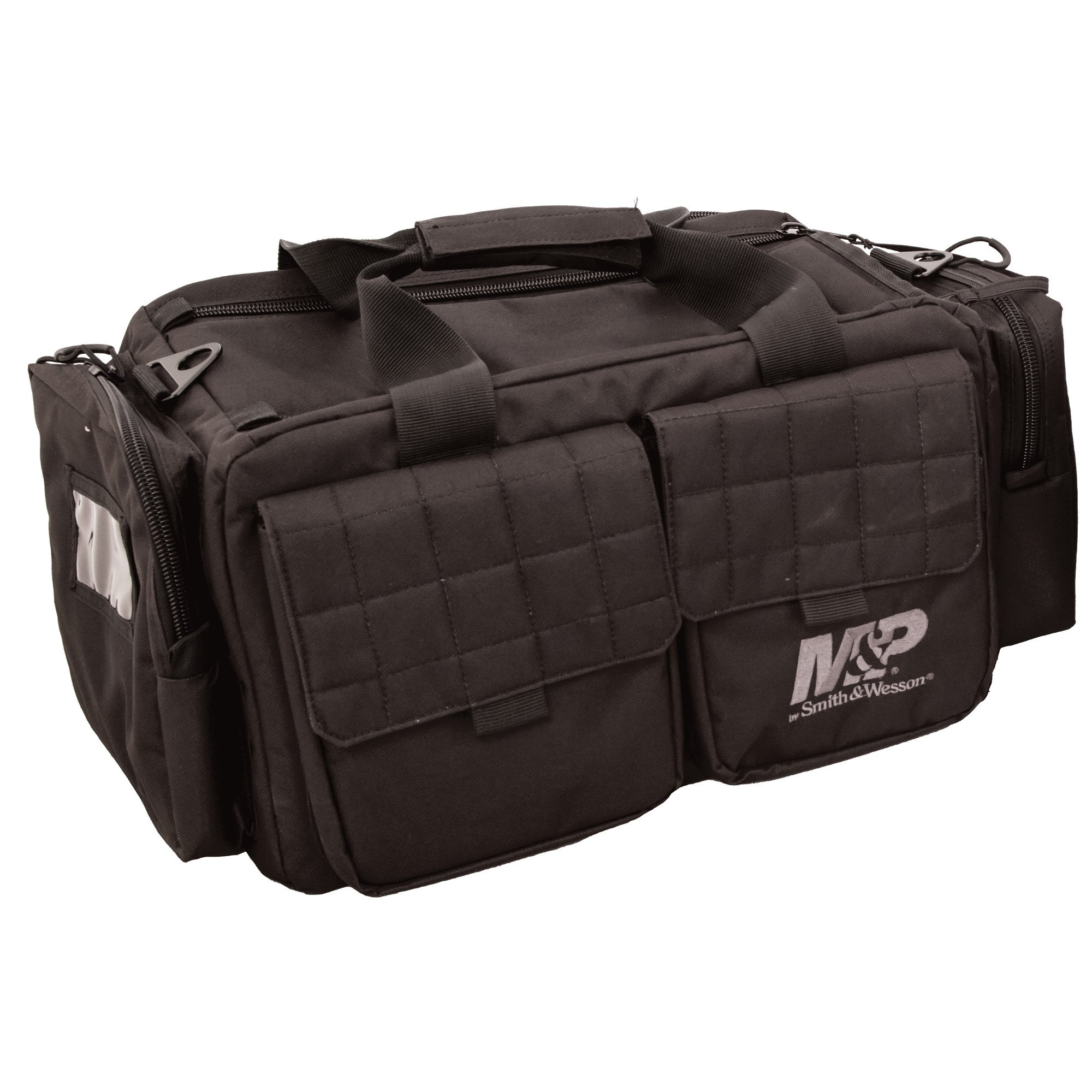
https://store.smith-wesson.com/shoo...wesson-recruit-tactical-range-bag/110013.html

Both bags came with the Smith & Wesson logo with black stitching otherwise I would have found a way to conceal it. Over 7 years of use and no issues.
 
I hope all the links work Since I'm in Canada it would not let me get on Samsonite USA. Also when I always power down before removing a lens. I never did with DLSR's but the sensor is further forward on mirrorless body. Advanced electronics as well. Protective caps go on right away.
 
Have you ever noticed that in most articles about cameras that the accompanying picture of the camera shows it with the lens off of it, and no body cap on it such that the sensor is exposed to the open air? In videos they wave it around like that as if it’s a stage prop.
I am under the impression that the last thing you want is to leave the sensor exposed to the open air in order to prevent dust or contamination from getting on the sensor. Am I being too paranoid? I have a little routine where I get everything set up with the replacement lens ready to go, and then frantically take one off and put the new one on. Speed is of the essence. Again, too paranoid?
This brings up another question. When you travel with your rig, do you leave the lens on the body, or do you take the lens off and put the body cap on? I can see a scenario where a really long telephoto could put pressure on the mounting ring, but I don’t have anything that long, my lenses are fairly short. I also usually only take one lens out when I shoot, mostly because I don’t want the hassle of fooling around with lenses while I’m in the middle of something.
Any tips, tricks, and opinions welcome.
I have thought the same thing. The other thing I've noticed which may be even worse is that they talk with the sensor exposed such that drops of water from their mouth can land on the sensor. It makes me cringe! Regarding travel, so far I have always travelled with a shorter lens that I keep on the body like a 24-105, or 24-70 mm lens.
 
I have thought the same thing. The other thing I've noticed which may be even worse is that they talk with the sensor exposed such that drops of water from their mouth can land on the sensor. It makes me cringe! Regarding travel, so far I have always travelled with a shorter lens that I keep on the body like a 24-105, or 24-70 mm lens.
Greg,
Cringe is a good word. It's like they have never heard about dust on the sensor. Unless you're in a NASA clean room, you don't wave it around like a wild man just to get a few more likes on their YouTube channel.
 
I have thought the same thing. The other thing I've noticed which may be even worse is that they talk with the sensor exposed such that drops of water from their mouth can land on the sensor. It makes me cringe! Regarding travel, so far I have always travelled with a shorter lens that I keep on the body like a 24-105, or 24-70 mm lens.
I just don't chug beer when I change a lens.

Screenshot 2026-09-23 at 11.33.32 AM.jpg
  • Join to view EXIF data.
 
Take off!! Beauty!!
Canada has given us many wonderful things, and near the top of the list is The Great White North, eh? Back in the day, when we saw each other, my buddy and I would automatically start speaking hoser Canadian. (How’s it going eh?…beauty) All our South Georgia neighbors thought we were crazy. We lived for the days when a new episode would come out. Rick Moranis and Dave Thomas are geniuses. Thanks for triggering me.
 
Take off!! Beauty!!
Canada has given us many wonderful things, and near the top of the list is The Great White North, eh? Back in the day, when we saw each other, my buddy and I would automatically start speaking hoser Canadian. (How’s it going eh?…beauty) All our South Georgia neighbors thought we were crazy. We lived for the days when a new episode would come out. Rick Moranis and Dave Thomas are geniuses. Thanks for triggering me.
Second City Television produced a few stars. John Candy to mention one.
 
Second City Television produced a few stars. John Candy to mention one.
All of those folks that came out of Second City were brilliant. They say that John Candy was a nice guy as well as an exceptional actor and comedian.
 
All of those folks that came out of Second City were brilliant. They say that John Candy was a nice guy as well as an exceptional actor and comedian.
He loved his perogies and never missed swinging by Alycia's when he was in town. He would order them when he was on a movie set. I grew up pretty close to that restaurant. My high school was three blocks away. I aways liked looking at his pictures on the wall went there for our feast. Scroll down and there is a picture of him. We have not been to the new location yet.

 
Have you ever noticed that in most articles about cameras that the accompanying picture of the camera shows it with the lens off of it, and no body cap on it such that the sensor is exposed to the open air? In videos they wave it around like that as if it’s a stage prop.
I am under the impression that the last thing you want is to leave the sensor exposed to the open air in order to prevent dust or contamination from getting on the sensor. Am I being too paranoid? I have a little routine where I get everything set up with the replacement lens ready to go, and then frantically take one off and put the new one on. Speed is of the essence. Again, too paranoid?
This brings up another question. When you travel with your rig, do you leave the lens on the body, or do you take the lens off and put the body cap on? I can see a scenario where a really long telephoto could put pressure on the mounting ring, but I don’t have anything that long, my lenses are fairly short. I also usually only take one lens out when I shoot, mostly because I don’t want the hassle of fooling around with lenses while I’m in the middle of something.
Any tips, tricks, and opinions welcome.
Transit. Lens or body cap. Most often a lens. But not a long one. Long lenses are removed for transport.

Storage. Lens or body cap. Most often a lens. But not a long one (mid-range zoom or short telephoto). (A 'grab and go' perspective, just in case something really exciting happens and 'any image' is better than 'no image').

Active use. I will happily womble around with a mid-range telephoto dangling or shortish telephoto (with or without a teleconverter). My (one and only) really long lens has its own strap and thus the stress on the mount is not via a lever-type action. However, advancing years tell me that should be for short(er) periods of time.

As a R body user with EF lenses, I leave the (pre-requisite) adapter fitted to the body. If I need to used the body cap it is put onto the adapter. The Canon documentation indicates the adapter should be fitted to the lens before both get attached to the body. My thinking - the body is powered off so how the heck does the body/circuitry detect that I've done it 'wrong'?

I have (in the past) switched lenses on a 5D without powering the body down. I think this may have been detrimental (given the dust I've had to digitally 'clean' off images). I now religiously power down the body before exposing the innards. The powering-down can also result in the lens being put into a 'parked' state.

(In this day and age, my definition of a mid-range zoom would encompas a lot of wide-angle up to short telephoto. And shortish telephoto means anything up to 200 - but dependant on size of front element and total weight).
 
My thinking - the body is powered off so how the heck does the body/circuitry detect that I've done it 'wrong'?
The camera isn't aware when it is off, but when you turn it on, the circuitry becomes alive and works exactly as designed. If you put the lens on with the body turned on, the body might get some bad signals as the live contacts slide over each other. Might. Usually we can get away with it.

Besides, you should turn the camera off to cover the sensor.
 

Latest reviews

  • Canon EOS R50
    5.00 star(s)
    Excellent Beginner's Camera, and a Very Good Enthusiasts Camera
    The R50 is a fine entry level/beginner/casual stills camera. It is not a pro level camera, but would be fine for hiking, street, family photos...
    • SwampGrizz
  • Canon EOS R6
    5.00 star(s)
    A nice camera specially if you want to save some money
    I bought the Canon R6 in 2024 to replace my Canon R7. After researching the market, I decided to go with the R6 instead of the R6 Mark II. Why not...
    • ctitanic
  • Prime Canon RF 50mm F1.2L USM
    5.00 star(s)
    Long Story Short Review
    10 years ago.....yes I said it was a long story! Canon sent me an EF 50mm f1.2 for a lens evaluation. On my 5D Mark III it was rather amazing. A...
    • GaryM
Back
Top