I learn something new every day.

Welcome to our Canon RF Shooters Forum

Be apart of something great, join today!

I've pushed my R6 and R6mkII up to 12,000 ISO and just used the denoise in Light Room. It's pretty amazing. I think I've pushed my R6 mkIII up to about 8,000 ISO.

Just wait until you discover flash. I eschewed it for so long but have recently started getting into it, and it's like the magic button that gives you the light you need when it's too dark.
Do you use off camera flash and do it indirectly? I know nothing about flash other than the kind of cheesy look that my in camera flash has. I think the kids these days like that sort of look, like they are at a rave party or something. I might look into an off camera flash and learn how to use it.
 
Thanks for all the replies. I’ve learned that a little noise/grain isn’t the end of the world, and in some cases will enhance the mood of the picture. I need to stop chasing perfection and live in the real world.

Topaz Photo recently added an optional 'Grain' function to put the tiniest bit of texture back into overly denoised images. You get your choice of Gaussian, Grey, and Silver Rich.... Wow.

When I think back to my darkroom days, I'm amazed at the tools we have available to us today.
 
I like calibrate my monitor but it is mostly to get the correct brightness. Lots of the people who like the detailed tech and pick things apart does help others. It's helped me so there is a place for everything. Just pick what's important to you. It's our art.
I agree; the brightness may often get ignored when calibrating a monitor. I wrote several related articles; this one is about brightness:
 
Do you use off camera flash and do it indirectly? I know nothing about flash other than the kind of cheesy look that my in camera flash has. I think the kids these days like that sort of look, like they are at a rave party or something. I might look into an off camera flash and learn how to use it.

Yes, I've started working with off camera flash. I recently bought an Westcott FJ100 and the FJ-T1M wireless trigger. I have this week also been renting an FJ400 for some shoots that I'm doing. I've sold my Canon EL-5 speed lights because Westcott has a bigger and deeper ecosystem of lighting.

If you are dealing with low light in a portrait or event setting, like weddings, off camera flash is a God send. It can make the difference between great photos and photos that are unusable. As good as the image sensors and noise reduction is these days, they don't beat actually having enough light to capture your subject. And when you start to use lighting in an artistic manner to get specific looks it's just the icing on the cake.

I recently did a wedding portrait workshop with single off camera flash which kind of tipped the balance for me on the benefits of off camera flash.

Here's a couple of those photos:

172A1033 by Justice Bigler, on Flickr

172A1052 by Justice Bigler, on Flickr
 
Do you use off camera flash and do it indirectly? I know nothing about flash other than the kind of cheesy look that my in camera flash has. I think the kids these days like that sort of look, like they are at a rave party or something. I might look into an off camera flash and learn how to use it.
Flash is an interesting topic. I spent months preparing for my first wedding and it was quite a journey. You can get a great flash shot. Good colour and exposure but it can look flat. It took me a while to figure out what flat meant.

JC shows what depth in his posted example -post #34. See one side of the face has lighting and the other is in shadow. In one of Syl Arena's books (well known flash photographer) said controlling the shadow area of the capture is more important and can be more difficult to achieve than the lit side. He also said look at a white piece of paper. Flat and boring. Now crumple it up and flatten it out. It has shape, texture, valleys, etc. I nicknamed what JC is showing the 3D look because it sort of is.

Off camera flash gives you "directional" lighting rather than strait towards your subject. Gives you the 3D look. This is also what bouncing the flash is about when it is on camera as well. Turn your flash head to the right and bounce it off a wall towards the subject in front of you. A few times when I shot a wedding and at the reception I knew the guests. One asked me why I'm always looking at walls and ceilings. Trying to find something to bounce the light off. :)

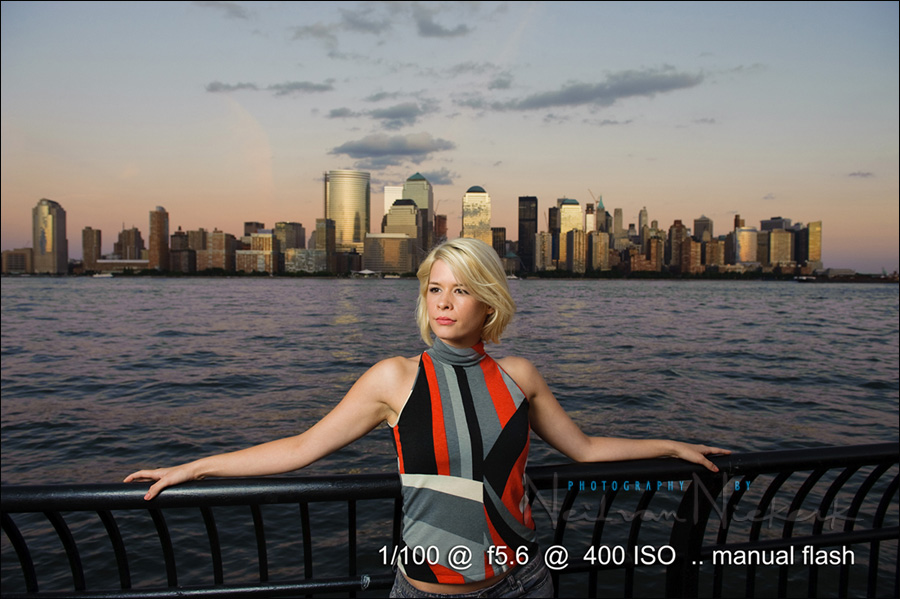
Unless you are in a studio, etc and are controlling all the light sources, on-camera flash is also interesting. You are controlling two exposes in one. The ambient light around you which your camera/meter controls, like in any kind of normal every day shooting. The flash controls subject exposure. See example below. Dragging the Shutter.

This is my on-camera flash guru. I spent a lot of time on this site preparing. In the blue column on the right - Flash Photography Techniques - has great info.

https://neilvn.com/tangents/

Dragging the shutter just means slowing it down. Scroll down and see how getting the correct same flash subject exposure for each frame but changing the shutter speed changes the ambient exposure.


Sorry for the long winded response. I love this subject.
 
Yes, I've started working with off camera flash. I recently bought an Westcott FJ100 and the FJ-T1M wireless trigger. I have this week also been renting an FJ400 for some shoots that I'm doing. I've sold my Canon EL-5 speed lights because Westcott has a bigger and deeper ecosystem of lighting.

If you are dealing with low light in a portrait or event setting, like weddings, off camera flash is a God send. It can make the difference between great photos and photos that are unusable. As good as the image sensors and noise reduction is these days, they don't beat actually having enough light to capture your subject. And when you start to use lighting in an artistic manner to get specific looks it's just the icing on the cake.

I recently did a wedding portrait workshop with single off camera flash which kind of tipped the balance for me on the benefits of off camera flash.

Here's a couple of those photos:

172A1033 by Justice Bigler, on Flickr

172A1052 by Justice Bigler, on Flickr
Nice work.
 
I once pulled up to a truck with these bullet whole stickers. I could not believe how real they looked. Notice the light and shading outside the black centre. The left and upper areas are darker. Depth shows realism. That is how those street painters, etc create the illusion of a set of stairs that don't exist.

r.jpg
 
This is brilliant stuff, no pun intended. I have a lot to dig on here. I had no idea what you could do with flash. The color in JC’s shots is first rate, and it doesn’t look like he used flash at all to me. I guess I got turned off by the deer in the headlights look that my on camera flash gave me, and didn’t pursue it much. I can see I need to go to school on this, and I thank all of you for sharing your expertise with me.
 
This is brilliant stuff, no pun intended. I have a lot to dig on here. I had no idea what you could do with flash. The color in JC’s shots is first rate, and it doesn’t look like he used flash at all to me. I guess I got turned off by the deer in the headlights look that my on camera flash gave me, and didn’t pursue it much. I can see I need to go to school on this, and I thank all of you for sharing your expertise with me.
Ahhh. Great Observation. The secret to flash photography is to make it look like you didn't use one. :) I had to read about it to figure that out. Of course if you are doing something where you intended to do so.
 
I guess I got turned off by the deer in the headlights look that my on camera flash gave me, and didn’t pursue it much.
I mean, you can definitely get that look. When I had my old Canon 60D years ago, it had that built in flash. And that's the way it looked when you used it. If you run the flash full out and straight on towards your subject and camera, then you get that flat washed out look.

When used right it adds to the natural illumination and can create specific looks. This workshop was pretty well designed, we had a goo location with lots of interesting background lighting. But it was also pretty dark. The only photo lighting was a single Westcott FJ 250 with a 36" octa box with diffusion panel and an egg crate grid. It would have looked completely different if we were using direct flash, or a shoot through umbrella.
 

Latest reviews

  • Canon EOS R50
    5.00 star(s)
    Excellent Beginner's Camera, and a Very Good Enthusiasts Camera
    The R50 is a fine entry level/beginner/casual stills camera. It is not a pro level camera, but would be fine for hiking, street, family photos...
    • SwampGrizz
  • Canon EOS R6
    5.00 star(s)
    A nice camera specially if you want to save some money
    I bought the Canon R6 in 2024 to replace my Canon R7. After researching the market, I decided to go with the R6 instead of the R6 Mark II. Why not...
    • ctitanic
  • Prime Canon RF 50mm F1.2L USM
    5.00 star(s)
    Long Story Short Review
    10 years ago.....yes I said it was a long story! Canon sent me an EF 50mm f1.2 for a lens evaluation. On my 5D Mark III it was rather amazing. A...
    • GaryM
Back
Top